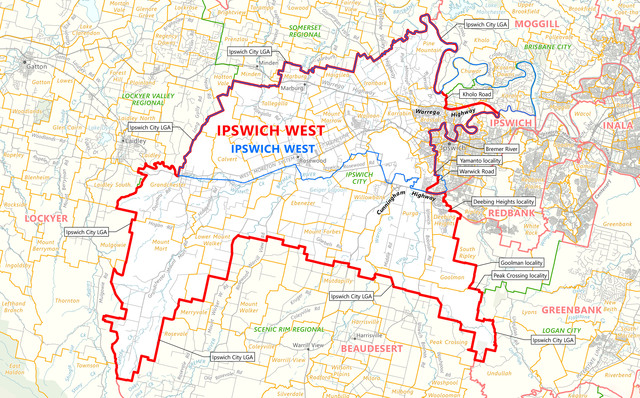
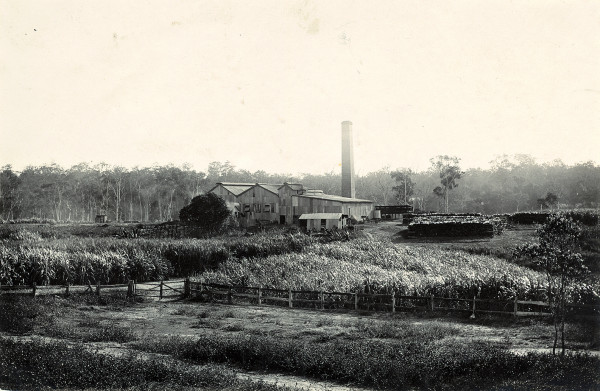
IT IS hard to imagine a time when the scrub grew in dense thickets where the towns and localities of Rosewood, Marburg, Walloon, Haigslea, Minden, Thagoona and Mount Marrow are found today.
Equally difficult to imagine are the hills and valleys, the lowlands and the creek flats swathed in crops.
And what crops they were!
The early settlers started with corn as a staple when they arrived and first began to clear their land but by the early 1880s the cultivations had begun to take on a very different look.
Many know the story of Charles Smith and his son Thomas Smith’s move into growing sugarcane in the Marburg area as an adjunct to their sawmilling operations.
By 1883, they had about 500 acres (200 hectares) of cultivation under sugarcane and opened a sugar mill to service their crop and the harvest of so many of the scrub farms. The establishment of a sugar refinery followed soon after.
Three years later they built a distillery to distil rum from the molasses produced in the refinery.
In those same years and for decades beyond, newspaper correspondents assigned to ‘wander through the farmlands and report on the farmers doings’ would report on the health of the vineyards in the area and the quality of the wine being produced.
Today, on reading these articles it is easy to interpret the words through the lens of the broad expanses of the grapevines in the vineyards of the Barossa Valley.
But that would be wrong.
The farmers, most of whom had immigrated from Germany, had brought with them bare rooted vines from their homeland. These were planted and using cuttings to strike more vines, the settler would slowly expand his vineyard.
So, while there were many small vineyards, there were few that would be considered of a commercial size – the wine produced initially was for home use but as more vines were planted it became a sell or trade commodity for some.
And this was the case for much of the fruit that made its way by rail or by wagon to the market in Ipswich.
The area in the five to six decades after the 1880s was renowned for its stone fruits and guava. But again, while there were some large orchards, most were small.
However, the combined harvest of so many small orchards was significant.
What may come as a surprise to readers is the news that crops such as pineapples and bananas once flourished in the district particularly on the slopes.
In 1898, there’s a report of a Mr Deuce, a farmer from Mt Cotton, who had established crops of bananas and pineapples at Kirchheim (today’s Haigslea).
He’d planted his crops from stocks bought from his Mt Cotton acreage and by the Spring of 1898 had planted a 1,000 banana plants and a like number of pineapple plants on the eastern slopes of Mt Marrow.
He’d purchased 50 acres (20 hectares) there and cleared it of scrub and timber and was particularly interested in expanding his banana plantation.
According to the report, Deuce had planted five different varieties of banana to assess which was best adapted to the scrub soil and the climate.
Another report from a journalist who’d spent a couple of days wandering through the countryside, described the farms around Kirchheim and Rosewood as “splendid”.
He was most impressed by the large orchards containing a wide variety of stone fruits; by the big groves of bananas; by the expanses of pineapples and by the vineyards and the product of the vineyards.
Fast forward 30 and 40 years and pineapples, and to a lesser extent, bananas were still being grown in commercial quantities in the area.
In a 1930 report, Fred Zabel was growing pineapples on his 360 acre (146 hectare) Sweet Mountain property at Minden.
According to the reporter, Mr Zabel had specialised in growing pineapples (10 acres), passionfruit (5 acres), strawberries (3 acres) and also bananas in addition to crops such as peanuts and arrowroot.
“The soil for the pineapples is ideal, and rising from the soil is fresh water in the form of a spring. The spring flows more rapidly as the land gets drier, and frees Mr Zabel from the worry of water shortage during a dry spell.”
Mr Donaldson’s farm on Marburg Hill a comparatively large acreage of bananas in addition to strawberries and rosellas and a sizable orchard of oranges, plums, mangoes and custard apples.
In the same report from the late spring of 1930, Mr Itzstein, whose farm was near Two Tree Hill on the Marburg Range, had specialised in growing cotton as well as other minor crop plantings.
And most of the farms also ran dairy cattle.
Drive around the same areas today and it is hard to imagine the thousands of hectares of fruit, sugarcane and cotton, which once grew there.