IT WAS advertised as The Grand Experimental Dinner to give prominent colonists a taste of native fare.
A unique concept in 1861, but considered a way to attract guests and raise the profile of the hosts, the recently formed and Melbourne-based, Acclimatisation Society.
The society’s main aim in its formation was the import of plants and animals from around the world to enrich the flora and fauna of the colony and in particular, one suspects, to try and make the local landscapes look properly British.
It was set up like a program of international exchange between acclimatisation societies, money didn’t necessarily change hands, initially it was more like …“we’ll send you some monkeys if you send us some anteaters (echidna) and duck-moles (platypus)”.
Promotion of the dinner was succour for the local pundits who enjoyed surmising some of the conversation around the table ahead of the banquet date.
One wrote, “in the greatest good humour”, some lines of conversation such as may be expected, could be … I wholeheartedly invite you to try a little bandicoot or perhaps some stewed leeches may be more to your liking … let me pass you some of this excellent white ant soup, no, then you must take a morsel of curried opossum or a taste of native companion (brolga), perhaps some fricassee of wild cat (quoll).
In reality, while the fare was of native animal origin, nothing was too confronting, although we suspect the frog patties, stuffed porcupine (echidna), fricandeau of wombat (meat wrapped in bacon) and the Murray turtle iced punch may have been avoided by the majority.
Much of the six course menu, with the exception of the dessert, was heavy on fish, wild duck, birds and chicken (not sure what native bird this referred to).
Reports about the dinner were that it was a success but most dwelt on the quality of the Australian wines that were served.
A NOTE FROM THE AUTHOR
I’m of an age when my primary school learnings about history tended to concentrate on the British explorers findings in our country; on knowing the train stations along the major lines in each state (I can still recite the stations where the Sunlander stopped between Brisbane and Cairns) and finally, the chief primary industries in each state.
I didn’t choose history as a subject in secondary school and my university studies were all about plants.
I was researching a totally different history subject when I came across the menu for the Acclimatisation Dinner and I was diverted.
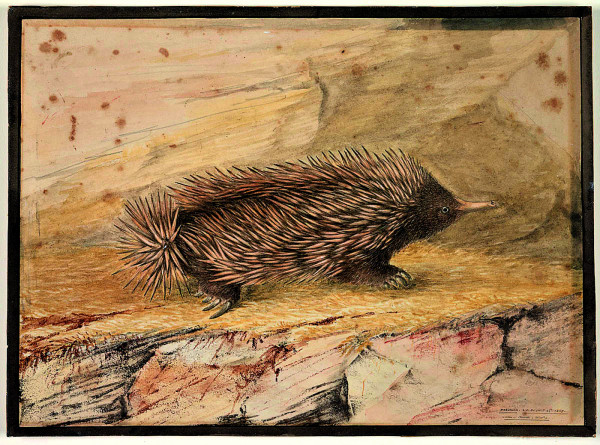
Reading through the many early articles which featured the creature then known as the porcupine anteater, I found I had to remind myself that it was a different time – a time when flora and fauna resources native to Australia were considered limitless.
Especially, for example, when I read a Letter to the Editor in an 1865 edition of The Australasian, where famous naturalist, botanist and botanic gardens curator, Ferdinand Mueller, exhorts readers to capture female duck-moles or platypuses and female porcupine anteaters to send to the British Museum.
“Such specimens should be preserved in strong spirits,” and sent to the Museum for study.
Or the article in 1863, about naturalist John St John who had spent more than three years in the bush collecting fauna specimens to support the setting up of a zoological museum in Melbourne. In the same article we learn that Mr St John is a taxidermist.
And one among many advertisements in 1841, about buying and selling porcupine anteaters, where a collector offers to sell well preserved specimens for £30, which he will carefully wrap in paper and place in a painted box before posting them off to buyers.
Due to my lack of learnings about the creature known as one of the ‘great Australian anomalies’, I searched for an article about how it was named.
One of the best I came across was written by John Wible for the Carnegie Museum of Natural History.
“Enroute to Tahiti in 1792, a ship put into Adventure Bay at Bruny Island off the coast of Tasmania, where the captain’s log made the first written account of an animal that was covered in thick, sharp quills with a pointy bill and small mouth.
“The ship was the HMS Bounty and the captain was none other than William Bligh. In the same year, a specimen from New Holland (Australia) arrived in the natural history department of the British Museum in London where it was formally described by assistant keeper George Shaw.
Shaw conceived of this animal as a cross between an Old World porcupine and a South American giant anteater.
He named it Myrmecophaga aculeata, a new species in the same genus as the giant anteater, Myrmecophaga tridactyla, and called it by the common name porcupine anteater; its formal name translates to spiny anteater.
The animal, about a foot in length, had been found amid an ant hill. Shaw’s account included the first image of the porcupine anteater.
A bewildering number of generic and specific names were applied to the porcupine anteater over the next two decades, reflecting changing views about its taxonomy.
The common thread was a realisation that this animal had little to do with the South American anteater and, therefore, could not remain as a species of that animal’s genus. Moreover, a second bizarre mammal from New Holland was described by George Shaw in 1799, the duck-billed platypus, Ornithorhynchus anatinus. Most authors recognised a kinship between these two odd forms. Today, we know them to be two types of monotremes or egg-laying mammals.
One of the generic names given to the porcupine anteater was Echidna, proposed by the famous French comparative anatomist Georges Cuvier in 1797.
In Greek mythology, Echidna was a hideous, flesh-eating monster with the top half of a beautiful woman and the body of a fearsome snake; Echidna was mother of many other infamous monsters, including Cerberus and Sphinx.
“For the porcupine anteater, this name was meant to reflect the animal’s mixture of reptilian and mammalian characteristics. However, the generic name Echidna was already occupied, having been given to a moray eel in 1788.
“So, by the rule of priority, it could not be used for the porcupine anteater. The name Tachyglossus, meaning rapid tongue for the speed with which it ingests ants, was proposed by Johann Karl Wilhelm Illiger of the zoological museum in Berlin in 1811.
“Thus, was born the formal moniker of Tachyglossus aculeatus for the porcupine anteater. Cuvier’s echidna stuck as the generally recognised common name.”