READING old newspaper articles on the various campaigns for a high-level bridge at the Seven Mile, one can understand the frustrations of the petitioners.
Our history column last month, gave some of the background to the push to have the first bridge replaced. It was built in the late 1850s and stood unremarked until the ‘greatest flood in history’ in 1893, when damage was caused to the bridge and its approaches.
Temporary repairs were made and damaged again, yearly, in every minor and major flood.
All agreed it must be replaced but disagreement erupted when it came to assigning the cost of a new bridge.
All agreed it must be a high bridge, but again, disagreement erupted when the costs were compared between a low bridge and a high bridge.
If ever there was a time when one could use the phrase ‘a bridge over troubled waters’, this was it.
The government was prepared to chip in the money for a low bridge, but if a high bridge was what they wanted, then the Mutdapilly Road Board and the Rosewood Road Board (the prototype to today’s local councils) must bear the difference in cost.
Agreement was finally reached after some heated words were exchanged in the press; the Boards would accept a like-for-like replacement low bridge.
The outcome was a regular outcry, often several times a year, when even a minor flood in the Bremer catchment would close the bridge to traffic.
The bridge was often referred to as ‘a blockade to progress’ particularly as the mines around Rosewood and Walloon began to employ more men.
The use of the word ‘blockade’ is understood when you read a letter to the editor in the Queensland Times, which was published on March 8, 1945.
“The refusal of the authorities to build a high-level bridge at the Seven Mile on account of expense and lack of manpower and materials appears absurd to the average person, particularly to those who have to travel daily over the route.
“According to our politicians coal is vital to our war effort … men, money and materials can always be found for the military side of the war, yet, apparently they cannot be found to ensure the continuous production of this vital war commodity.
“ … we miners who have had occasion to travel the ‘alternative roads’ [when the Seven Mile is flooded] know that even with small utility trucks, those roads mean some hours of pushing through ankle-deep mud and extricating bogged vehicles … and for buses, those roads are impassable.”
The reply to this letter from the Co-ordinator General and Commissioner for Main Roads, John Kemp, may have been almost as frustrating as the ever-flooding bridge.
“The road [between Rosewood and Ipswich] now, is infinitely better to travel on than before the Main Roads Commission became responsible for it … the building of a high-level bridge would be a work of considerable magnitude and could not be undertaken at present.
“There are alternative roads to Rosewood which could be used in flood time.”
But before we go further, let’s peddle back to 1941, when the road and the bridge were under the stewardship of the Normanby Shire Council (headquartered in Harrisville and formed from a portion of the Mutdapilly Division) and the Moreton Shire Council (formed from the amalgamation of such localities as Brassall, Bundanba (as Bundamba was spelt back then), Lowood, Purga and Walloon).
The Normanby Shire Council delegates, during a deputation to a Moreton Shire Council meeting advised that it had successfully sought a loan from the Treasury to meet half the cost of building a new Seven Mile Bridge … and now, fellow sirs, you need to cough up your half (my words), was the general drift of the discussion.
Paraphrasing again, the Chairman of the Normanby Shire Council, Edward Hayes, was adamant that the bridge was on the boundary of the two Shires … despite advice to the contrary by the Main Roads Commission … and the Moreton Shire must meet half the cost of the bridge.
Some serious checking of records and maps following the meeting proved that the border of the Moreton Shire cut across a small portion of one corner of the bridge … and Moreton councillors agreed to meet a one-half share of the costs.
After World War II, the campaign for a high-level bridge gained new momentum, driven again by the coal mining fraternity. Around that time there was an estimated 534 men working in the mines around the Rosewood and Walloon districts and many drove to work from Ipswich.
Yet it seems that all these negotiations and begging and pleading by bridge users and subsequent outrage over promises made and broken, were all for nought.
And so, the several-times-a-year reports in the local newspapers of floodwaters over Seven Mile Bridge continued.
In 1949, the Normanby Shire was abolished and its land area was shared between the Moreton Shire and the Boonah Shire. The Rosewood Shire was also abolished and became part of the Moreton Shire.
As a result, it seems, the bridge was pushed down the list of priorities.
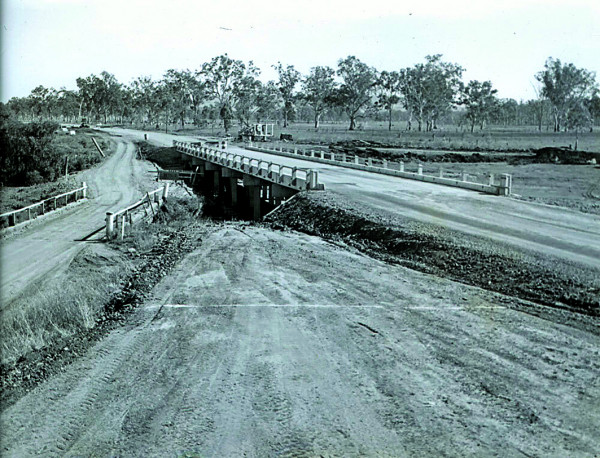
A high-level bridge at the Seven Mile was finally constructed in 1968.
The wheels of government grind slowly …