THE cutoff date for public submissions closed at the weekend on design plans for the historic Stone Quarry Cemetery at Jeebropilly.
The proposed final design includes sectioning off an area for an Islamic cemetery after a petition last year requested such a section at one of the local cemeteries.
The plans will be considered at a forthcoming Ipswich City Council meeting.
The council drafted a preliminary design identifying about 690 potential burial plots at the cemetery at Jeebropilly [flying squirrel gully].
Traditional burials for a person of Islamic faith place the body in a north-south orientation and which does not allow for the body to be placed in a coffin or casket.
The body is placed on its right side towards Mecca on a layer of sand and then covered with a platform of wood to prevent the body from contacting the soil.
The Mt Gravatt Cemetery in Brisbane is the nearest cemetery with an Islamic section and there is no capacity for expansion there.
The historic cemetery first opened in 1875 and features many burial sites of the first settlers.
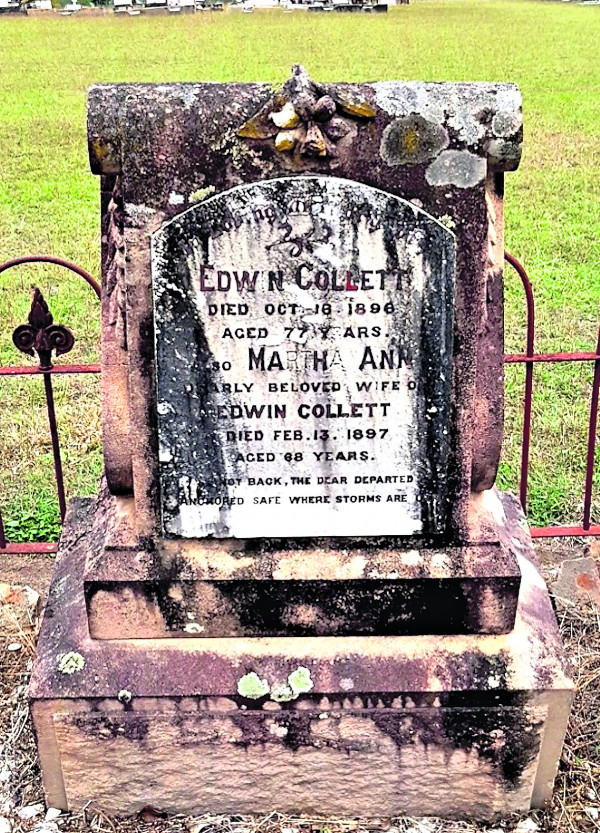
One of those is of Edwin Collett who was born at Woodchester in England in 1819.
He married Martha Ann (nee Baston) from nearby Rodborough.
Once they were married, they initially settled in the small village of Amberley.
Edwin, Martha, and their son William sailed out of Southampton bound for Brisbane in Australia and arrived in Moreton Bay on the sailing ship The Parsee on February 9, 1857, to move to a new life in the colony which became a separate state of Queensland in 1859.
The couple were pioneers of Ipswich and named their selection ‘Amberley’ after their home village near Stroud in Gloucestershire.
Edwin died in 1896 at the age of 77, and less than six months later his wife Martha Ann Collett died, and the couple was buried at Stone Quarry Cemetery (then known as the Ebenezer Quarry.
RAAF Base Amberley began operations in 1940 and was so named after the Collett’s selection.