I HAVE been an avid reader ever since I first learned to sound out words.
My unswerving preference has been fiction.
Books with a big cast of characters, whose creators were skilled in the craft of developing believable personalities and dialogue and flowing story plots.
If that criteria was met, then I was eclectic in where those characters were placed – in a science fiction, historic or modern day universe – it didn’t matter.
Give me a moment’s spare time and I look for something to read, even if it is only the back of a cornflakes packet.
But my choice, until recently, has always been fiction. I’d read so much non-fiction in my working life, I have not sought it out when I had some time to relax.
My attitude changed recently when two of my sons talked me into dipping into the world of non-fiction.
They persuaded me that I shouldn’t judge without first sampling some of the good reads they recommended.
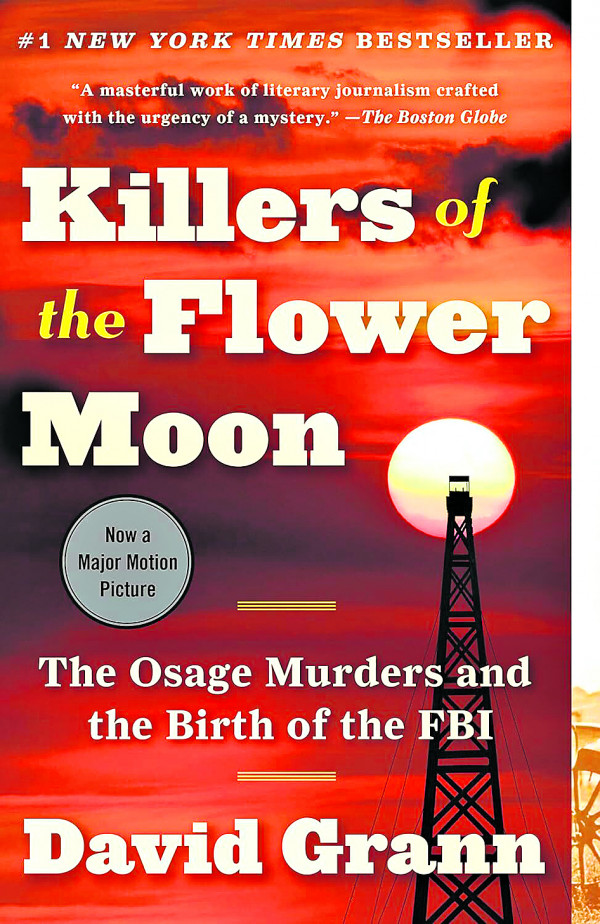
My first venture into what I had envisaged as a fairly humdrum universe was ‘Killers of the Flower Moon’ by David Grann.
Contrary to the best homespun advice, I did choose the book by its cover, more correctly by its name. Who could resist?
Billed as a ‘twisting, haunting true life murder mystery about one of the most monstrous crimes in American history’ which was the catalyst for the ‘birth of the FBI’ it seemed it could be more a fiction, than a non-fiction, narrative.
I found it was a compelling read of a repulsive saga of misery, greed and corruption.
No fiction here – just a carefully researched, eloquently written, thought-provoking narrative.
My next dip into non-fiction was by the same author.
Its title, too, also appealed to the journalist in me.
The book was entitled ‘The Wager: A Tale of Shipwreck, Mutiny and Murder’.
The storyline chronicles the shipwreck of the HMS Wager when rounding Cape Horn in 1741, while in pursuit of a Spanish galleon nicknamed the ‘prize of all the oceans’ due to the treasure in its hold. The shipwrecked crew of the Wager become castaways on a desolate island off Patagonia and a ‘Lord of the Flies’ situation evolved.
Tight prose, written in a style that entices you to read on through to the last chapter, where you are disappointed – not in the ending, but the fact that it has come to an end.
As a history buff, my next foray into the non fiction category was ‘The Money Kings’ by David Schulman. The choice was prompted by reading the summary and learning it was about the Jewish immigrants who helped shape America.
I had always wondered how a trio of Jewish Latvian brothers had ended up in a sparsely populated, scrub country some distance from the fledging city of Ipswich.
The Blumberg brothers helped found the town of Boonah through their generosity, their willingness to share their skills in helping establish community groups and their quick acceptance by the German settlers.
In reading ‘The Money Kings’, I gained the understanding I was hoping for and so much more, in this rich history about the transforming of Wall Street and the founding of the financial dynasties with familiar names like Goldman, Sachs, Lehmann, Loeb and Seligman. In telling the interconnected origin stories of the families, Schulman reveals the roles the ‘Money Kings’ played in turning the United States from a debtor nation into a financial superpower.
A fascinating read.
Other books that have appealed to my now avid desire to remain in the world of non fiction include ‘The Surgeon of Crowthorne’ by Simon Winchester, ‘The Bomber Mafia’ by Malcolm Gladwell and ‘The Lost City of Z: A Tale of Deadly Obsession in the Amazon’ by David Grann.
However, John Valiant’s ‘Fire Weather: A True Story from a Hotter World’, I classify as my most riveting non-fiction read to date.
I bought the book because it was about wildfires. I thought as I have written articles about bushfires so regularly in my career, it would be good to broaden my ‘fire’ vocabulary and my understanding of wildfires.
A couple of chapters into the book, I became so engrossed I forgot about ‘this will be good for you tag’ and found that all I wanted to do was forget about all the other happenings in my life, and read on.
Valiant backgrounds the drama of one of the world’s most damaging wildfires, with the history of how fire has shaped humankind, the birth of North America’s oil industry and the emergence of climate science.
His account of the multi-billion-dollar wildfire disaster that swept through the city of Fort McMurray in Canada during May 2016 is brilliant.
If it was fiction, a reader might dismiss it as a well told, but unbelievable, tale.
The fact that it is true, heightens the drama of his prose, and frankly, is shocking.
A ‘must read’.