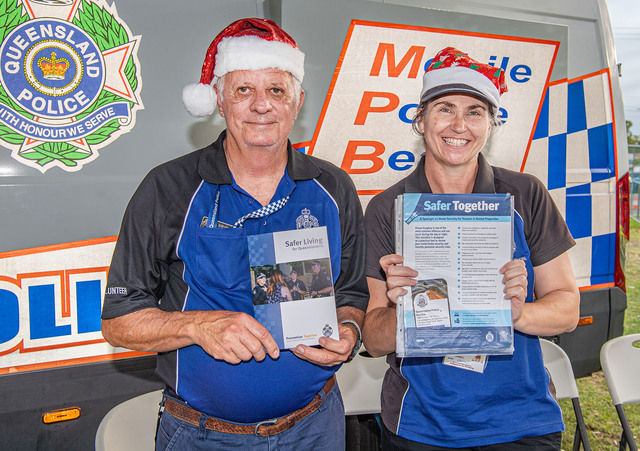

ARE YOU receiving text messages, emails or unfamiliar requests, Officer in Charge at the Rosewood Police Station, Sergeant Travis Ehrich is asking community members to be extremely cautious of any contact that may well be a scam.
Sgt Ehrich was a detective at the Ipswich Station prior to his current posting and had investigated many frauds and was aware of hundreds more.
“Many of these frauds took the form of a scam, and usually originated on an online dating site or a hacking event or from a message known as phishing,” he said.
“I am personally aware of victims in the Ipswich district that have lost their lifesavings and hundreds of thousands of dollars to the fraudsters.
“Unfortunately older members of our community are over-represented in these statistics.
“Worse still, it is likely that if you are a victim to these offenders you may never recover your lost finances, even if the offenders are caught.”
A representative from Queensland Police said that scams may be presented to you personally, through mail, phone or over the internet and the approach may be from a person you regard as a good friend or may be a person you have recently met.
“They offer to improve the quality of your life in some manner at minimal or no risk and they are usually very professional in their approach and often use associates and professional looking documents to support their offer,” he said.
“Some examples of scam messages are a fake text or email sent by a hacker to you which looks like it was sent from one of your family or friends and it will typically say that they have lost their wallet and need you to deposit a small sum of money into their account urgently.
“They will also attach a BSB and account number. If this occurs always call the actual person the message came from and speak with them to verify if the message actually came from them.”
Scammers are also targeting families who may be trying to sell or buy items on the internet, in many instances asking for money without any return of the actual product that they are advertising to sell.
“Many older people fall victim to scams known as romance scams, this involves a fraudster setting up a fake profile on an online dating application and tricking the victim into sending them money or inadvertently laundering proceeds of crime,” he said.
“The fraudster may act like a regular person for many months at the commencement of the relationship to gain trust but will eventually have a crisis story involving medical expenses or a sick overseas relative and request the victim to send money.
“This will continue until the victim questions their validity and the person will delete their profile and disappear.
“If the person is reluctant to meet in person, if the person regularly asks for money or asks you to set-up an Australian bank account for them, then it is most probably a scam.
“If the person deposits cash into your account but wants you to then on-forward the money to another account, this is a sign that they are treating you as a money-mule to launder money.”
The message is that if you are unsure, delete and restrict the details straight away, as the old saying goes, if it is too good to be true, more often than not, it probably is.