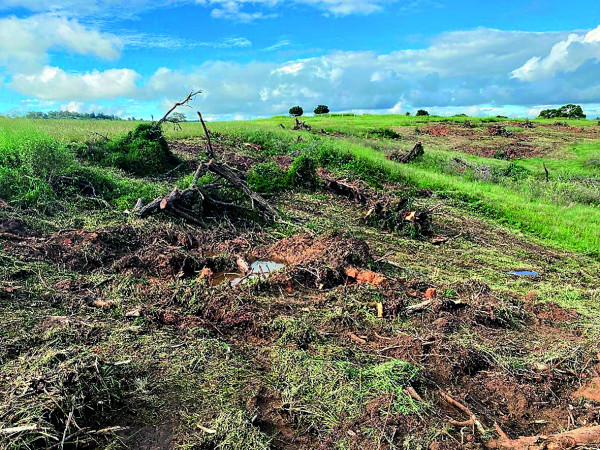
IT IS estimated that hundreds of thousands of trees will be required to lower the groundwater table at Marburg and the Ipswich City Council is urging more landowners to put their hand up to help in the battle against salinity.
Ipswich Mayor Teresa Harding said the salinity issues in the Black Snake Creek Catchment, which encompasses Marburg, are largely attributed to the loss of deep-rooted native vegetation throughout the catchment and the local geology of the region.
“The loss of vegetation, through years of farming and land clearing, causes the groundwater table to rise, bringing salts which are released into Black Snake Creek,” she said.
“Given most of the land surrounding Black Snake Creek is privately owned, council must rely on the willingness of landowners to play a role in improving the quality and health of the catchment.
“To date, council has worked in partnership with landowners to plant more than 20,000 trees in the Black Snake Creek Catchment to help reduce salinity issues in the area.
“Council’s strategic planning in this catchment identifies the restoration of deep-rooted native vegetation as a key action that will help lower the groundwater table and reduce salinity.
“We continue to work with landowners, local groups and through regional partnerships such as the Resilient Rivers Initiative to improve salinity issues in the Black Snake Creek Catchment.”
Deputy Mayor Councillor Russell Milligan added that the salinity in the soil represents a complex challenge.
“This challenge requires an all-in approach from all levels of government, natural resource management bodies, private landowners and other stakeholders,” he said.
“We are tackling an issue that has been caused by more than a century of land clearing and agricultural practices, and there are no quick fixes.
“Council is working with local landowners throughout the Marburg area with funding through the South East Queensland Council of Mayors Resilient Rivers Initiative to plant trees on private properties.”
Cr Kate Kunzelmann said that council was currently seeking public input on the new draft Ipswich Planning Scheme, which includes a water resource catchment overlay code.
“This code is based on mapping of the water resource catchments, which includes Marburg.
“The purpose of the Water Resource Catchments Overlay Code is to ensure development and activities within the water resource catchments and water supply buffer are appropriately sited, designed, and managed to maintain water quality, flow regimes, environmental values and the physical integrity of natural processes to protect the drinking water supply,” she said.
“These components are not in the current Planning Scheme and they will apply to new developments undertaken once the Ipswich Plan 2024 is in effect.”